
Which states have the highest dropout rates and does gender play a role?
- Jul 16
- 5 min read
Updated: Jul 18
Introduction
Education plays a crucial role in improving people’s quality of life and creating better opportunities for the future. Despite this, many students across India leave school before completing their education, a challenge commonly referred to as school dropout. High dropout rates affect literacy, employment, and economic development, making them an important indicator of educational progress. Understanding where these dropouts occur and whether boys or girls are more affected can help governments and educators design more effective policies.
This report explores the research question: Which states have the highest school dropout rates in India, and does gender play a role? The analysis is based on dropout data from the 2012–13 academic year, covering all Indian states and union territories. The data was visualized using Tableau to compare dropout rates across states, education levels, and gender, helping identify regional patterns and differences.
State-wise Analysis
Figure 1

The primary school dropout data (Figure 1) highlights clear differences between states. Mizoram stands out as the clear outlier, recording a primary school dropout rate of around 24%, far higher than any other state. It is followed by Arunachal Pradesh, Uttar Pradesh, Meghalaya, and Manipur, where dropout rates range between approximately 10% and 15%. These states appear to face greater challenges in keeping children enrolled during the early years of schooling.
At the other end of the spectrum, Kerala, Puducherry, Himachal Pradesh, and Goa record some of the lowest primary dropout rates, with figures close to zero. This suggests that students in these regions are far more likely to complete primary education. Overall, the data shows that dropout rates are concentrated in a few states, while most maintain relatively low levels.
Gender Analysis in Primary Education
Figure 2

Breaking the primary school data down by gender (Figure 2) reveals an interesting pattern. In many states, boys record slightly higher dropout rates than girls, although the differences are generally small. States such as Arunachal Pradesh, Meghalaya, and Uttar Pradesh show comparatively high dropout rates for both genders, suggesting that regional factors have a stronger influence than gender alone.
States with high overall dropout rates also tend to record higher values for both boys and girls. This suggests that challenges such as poverty, limited educational infrastructure, difficult terrain, or reduced access to schools affect entire communities rather than one specific gender. Although boys have slightly higher dropout rates in many states, the gap is relatively small, indicating that gender plays only a limited role during primary education.
Comparison Across Education Levels
Figure 3

Comparing all education levels reveals a clear pattern. The heat map (Figure 3) shows that secondary education consistently records the highest dropout rates in most states. Darker colours are concentrated in the secondary education column, while primary and upper primary education generally display lighter shades, indicating stronger student retention during the earlier years.
States including Odisha, Karnataka, Nagaland, Assam, and Meghalaya continue to record relatively high dropout rates across multiple education levels, suggesting long-term challenges in keeping students enrolled. As students move into secondary education, factors such as increased academic pressure, financial difficulties, family responsibilities, and the need to work may contribute to higher dropout rates. These findings shift the focus to secondary education, where student attrition is highest.
Secondary Education Analysis
Figure 4
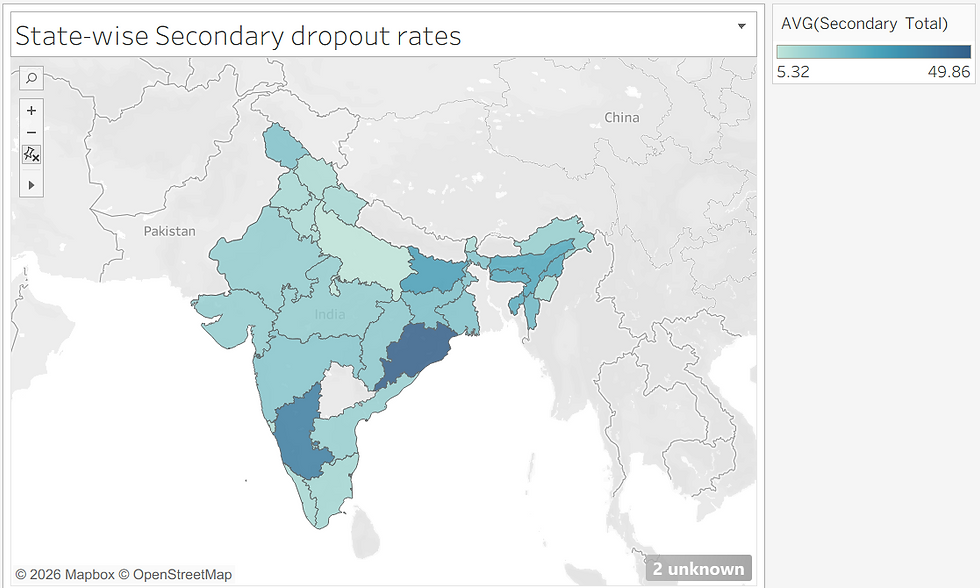
The state-wise secondary dropout map (Figure 4) presents a much more serious picture than the primary school analysis. Odisha records one of the highest secondary school dropout rates at nearly 50%, while Karnataka also reports an exceptionally high rate of around 40%. Other states, including Bihar, Assam, and Meghalaya, also experience comparatively high levels of student dropout.
Compared with primary school, the increase is striking. States that successfully retain students during primary education often experience a substantial rise in dropout rates once students reach secondary school. While the dataset does not explain the exact reasons behind this trend, factors such as increased educational costs, examination pressure, employment opportunities, and family responsibilities may contribute. Overall, secondary education is the most vulnerable stage within the education system.
Gender Analysis in Secondary Education
Figure 5
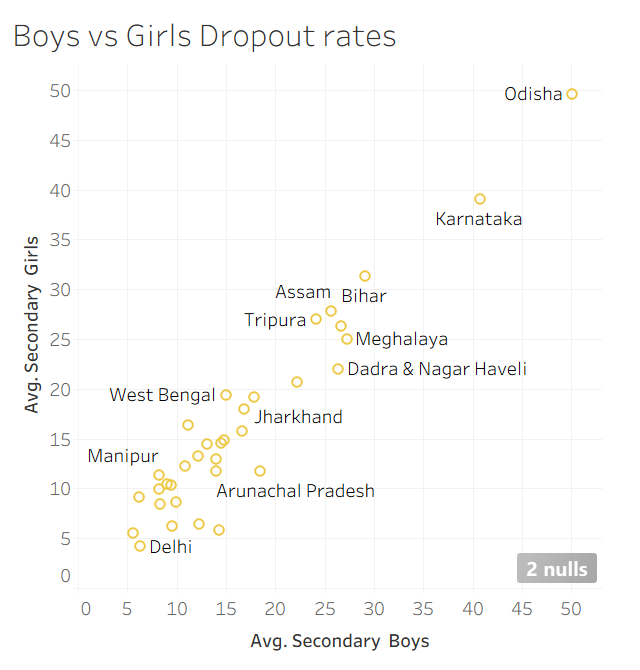
The scatter plot comparing boys’ and girls’ secondary school dropout rates (Figure 5) shows a strong positive relationship. States with high dropout rates among boys generally report similarly high dropout rates among girls. Odisha, Karnataka, Bihar, and Assam all fall into this category, indicating that broader regional conditions affect both genders.
Unlike the primary school data, however, the gender gap becomes more noticeable during secondary education. In some states, boys experience higher dropout rates, while in others girls are more affected. Instead of following one national pattern, gender appears to interact with local social and economic conditions. This suggests that although gender influences dropout rates, regional factors remain the stronger overall influence.
Overall Education Level Comparison
Figure 6
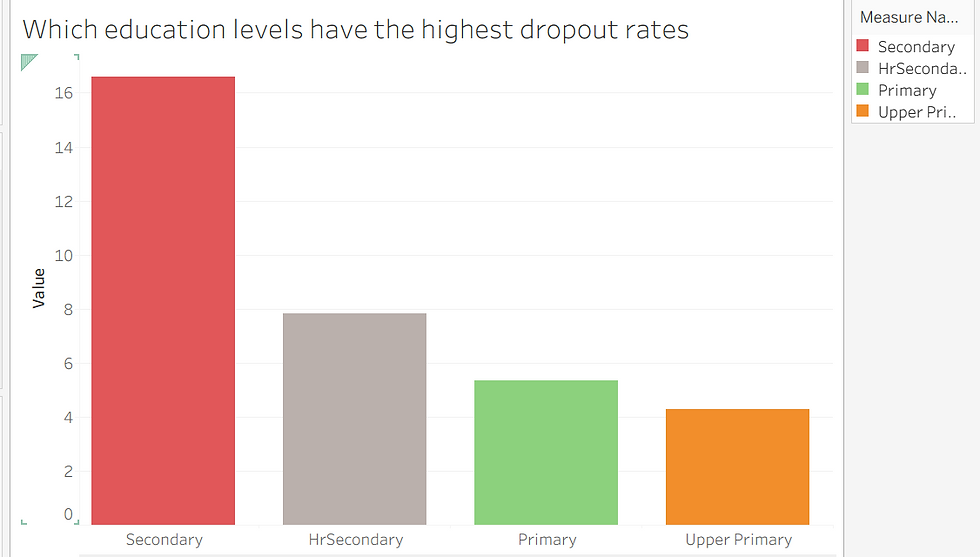
The average dropout rates across all education levels (Figure 6) reinforce the earlier findings. Secondary education records the highest average dropout rate at approximately 16.6%, followed by higher secondary (7.8%), primary (5.3%), and upper primary (4.3%).
This comparison highlights that the transition into secondary education is where the education system loses the greatest number of students. While many children complete primary school, maintaining student participation becomes much more difficult during the secondary years.
Gender Gap Analysis
Figure 7

The gender gap chart (Figure 7) shows that differences between boys’ and girls’ secondary school dropout rates vary considerably across India. Tamil Nadu records one of the largest positive gender gaps, while Madhya Pradesh displays one of the largest negative gaps, showing that neither boys nor girls are consistently more affected nationwide.
Most states show relatively small gender differences, suggesting that geography has a greater influence than gender itself. Local economic conditions, cultural expectations, and access to education appear to shape these differences, meaning the impact of gender varies from one state to another.
Conclusion
The analysis shows that school dropout rates differ significantly across India, with certain states facing much greater challenges than others. Mizoram records the highest primary school dropout rate, while Odisha and Karnataka experience some of the highest dropout rates during secondary education. Across all education levels, secondary education has the highest average dropout rate, making it the stage where students are most likely to leave school.
Gender does influence dropout rates, particularly during secondary education, but its impact is not consistent across every state. Instead, regional factors such as economic conditions, educational access, and local circumstances appear to have a greater overall influence on whether students remain in school. One limitation of this study is that it relies on data from only the 2012–13 academic year, and some higher secondary values were unavailable. Even so, the findings provide useful insights into dropout patterns across India and highlight areas where future educational policies could improve student retention.


