
Which academic, lifestyle, and financial factors are most strongly associated with depression among university students?
- Jul 15
- 4 min read
Depression is becoming an increasingly important issue among university students, affecting both academic performance and overall well-being. This project seeks to examine the relationship between academic, lifestyle and financial factors and depression in a dataset of student mental health from a sample of students. Data includes information on academic stress, sleep duration, financial stress, satisfaction with studies undertaken, work pressure, diet, and family history of mental illness.
The mental health of students attending university is exposed to various academic, financial and lifestyle issues that can affect their well-being. Depression is becoming more prevalent amongst students, but it can be challenging to determine which factors are most closely correlated with depression. Familiarity with these relationships may enable universities, educators and students to identify the risk factors and promote students' well-being. This project will investigate the following research question: What are the most strongly associated academic, lifestyle and financial risk factors for depression among university students? This investigation examines several variables in the data set to find those that have the greatest association with depression and to look for patterns that might contribute to understanding student mental health.
Data was analysed with descriptive visualisations in Tableau. A pie chart was used to gain an understanding of the overall distribution of depression and to make comparisons between depression status and different academic, lifestyle and financial factors using side-by-side bar charts. It was not the intention of the analysis to identify cause-and-effect relationships but rather trends and differences between students with and without depression.
Figure 1: Distribution of Depression
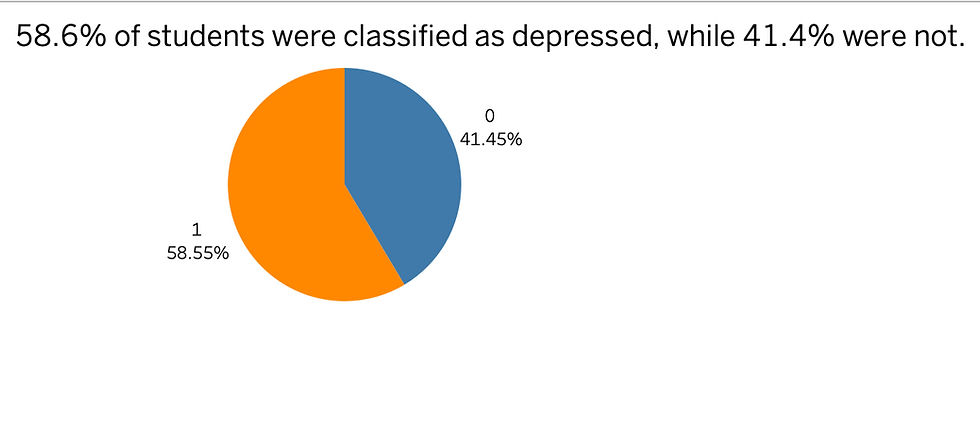
As seen in the figure 1, 58.6% of the students in the data set were identified as having depression and 41.4% were not identified as having depression. This suggests that depression is a key issue to explore further as it is a substantial percentage of students in this sample who are suffering from depression. There was a high prevalence of depression among the students (over half reported depression), which is important to consider when attempting to answer the research question.
Figure 2: Academic Pressure vs Depression

As seen in Figure 2, there is a clear trend that those who feel more academically pressured are more likely to be diagnosed as depressed students. Students with depression are more common in the high pressure level, and more common in the low pressure level among students who do not have depression. This indicates that, in the data set, academic stress is among the most important academic factors linked to depression.
Figure 3: Sleep Duration vs Depression

Figure 3 is a comparison of sleep duration to depression status. Generally, students who report shorter sleep times tend to have higher rates of depression than those with healthier sleep habits. This indicates that lifestyle changes, especially sleep habits, could be an important factor in students' mental health and that they are strongly linked to depression.
Figure 4: Financial Stress vs Depression

As can be seen in Figure 4, the more that a student is stressed about finances the more likely they are to feel depressed. Low financial stress students are 13% less likely to experience depression compared with those students who report no financial stress.Students who experience a higher level of financial stress demonstrate significantly higher depression levels at 31%. This suggests that the financial stress is a key factor that is related to student mental health.
Figure 5: Study Satisfaction vs Depression

According to Figure 5, students' study satisfaction level has a positive correlation with the number
of students who do not have depression, and a negative correlation with the number of students who have depression. It implies that satisfaction in learning experiences could be related to the students' mental well-being.
Figure 6: Work Stress vs Depression

From the graph (Figure 6), it is observed that the students who feel higher work pressure feel more cases of depression than those who feel lower work pressure. There are limited categories of work pressures in the data, but the general trend indicates that higher levels of work pressure can have a negative effect on mental health among university students.
Figure 7: Family History of Mental Illness vs Depression

Students with a family history of mental illness are more likely to be depressed than those without a family history as seen in Figure 7. The familial pattern indicates that certain factors related to depression may be due to family factors and underscores the importance of personal and family factors on mental health.
Figure 8: Dietary habits and depression

As seen in Figure 8, the students' eating habits were also compared with depression status and it was found that, in general, students with poorer eating habits had higher depression scores than the ones who had healthier eating habits. There is a link between diet and depression, although it alone does not cause depression, the findings indicate that people with healthier lifestyle habits might experience better mental health.
The findings suggest that depression among university students occurs due to a combination of academic, lifestyle and financial factors and not necessarily a single factor. The strongest and most consistent findings for depression were with academic pressure, financial stress and low satisfaction with study; other factors that were associated with depression clearly were shorter sleep duration, higher work pressure, poorer diet and family history of mental illness. The results indicate the importance of different multi-faceted factors in relation to the mental health of students, and the need to support students both academically and personally. This analysis does reveal patterns within the data that are meaningful, but it is a demonstration of associated patterns rather than a statement of cause and effect as to the causes of depression.


