
The Plane That Was Too Big for the World
- Team Futurowise

- Jun 23
- 4 min read
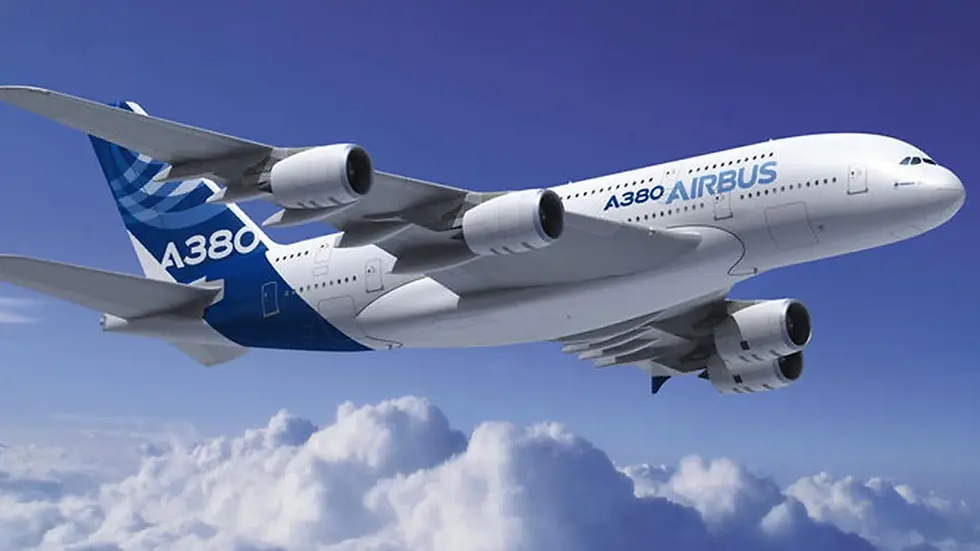
On 27 April 2005, a crowd of fifty thousand people gathered at Toulouse-Blagnac Airport in southern France. They had come to watch something most of them did not believe could fly. A test pilot named Jacques Rosay sat at the controls of an aircraft registered F-WOWW, an aircraft so large it seemed to defy the logic of flight itself. It weighed over five hundred tonnes. It stood as tall as a seven-storey building. When Rosay pushed the throttles forward and that enormous machine lifted cleanly off the runway, the crowd did not just cheer. Some of them wept.
This was the Airbus A380, and for a brief, dazzling moment, it was the future of flying.
The Bet on Bigger
To understand the A380, you have to understand the argument behind it. In the 1990s, Airbus looked at the crowded skies of the future and made a prediction. As more people flew, the world's biggest airports would run out of room. The solution, Airbus believed, was not more flights but bigger planes. Fly enormous aircraft between a small number of giant hub airports, then let smaller planes carry passengers onward. Aviation engineers call this the hub-and-spoke model.
Boeing had owned this part of the market for thirty years with its iconic 747, the original jumbo jet. Airbus wanted to build something that would make the 747 look small. The project was formally launched on 19 December 2000 with a budget of 9.5 billion euros, and the number 8 in the name was chosen partly because its shape echoes the aircraft's double-deck cross-section, and partly because 8 is considered lucky across much of Asia.
The numbers it eventually achieved are still difficult to absorb. The A380 stretches 72.7 metres from nose to tail, with a wingspan of nearly 80 metres. In an all-economy layout it is certified to carry up to 853 passengers. It is the only passenger aircraft ever built with two full-length decks, an upper and a lower floor running the entire length of the cabin.
When Five Hundred Kilometres of Wire Went Wrong
Building something this large turned out to be far harder than designing it. The A380 was assembled from parts made across France, Germany, Spain, and the United Kingdom, then shipped to Toulouse for final assembly. And here a small detail caused an enormous problem.
The German and French design teams were using different versions of the same design software, a program called CATIA. The aircraft needed roughly 500 kilometres of electrical wiring threaded through its frame. Because the software versions did not match perfectly, the wiring designed in one country did not fit the airframe built in another. The wires were simply too short.
The result was brutal. Production was delayed by two years. Development costs spiralled from the original estimate to a staggering figure of around 25 billion dollars, more than double what Airbus had planned. It is a powerful lesson hiding inside a glamorous machine. The hardest part of a megaproject is often not the engineering of the object itself. It is the coordination of the people building it.
A Palace in the Sky
When the A380 finally entered service with Singapore Airlines on 25 October 2007, passengers discovered something airlines had never been able to offer before. Space.
Emirates installed onboard shower spas. Several airlines fitted cocktail bars and lounges on the upper deck. The cabin was quieter than any large aircraft before it. For a while, flying the A380 was not just transport. It was an event. The aircraft built a genuine fan following, with enthusiasts tracking individual planes and gathering at airport fences just to watch one land.
Quietly, the A380 also built one of the finest safety records in aviation. By the time production ended, the global fleet had completed more than 800,000 flights with no fatalities and no aircraft lost.
Why the Giant Stopped
And yet, in February 2019, Airbus announced it would stop building the A380. The last one was delivered to Emirates in 2021. Only 251 were ever made. So what happened?
The world Airbus had predicted did not arrive. While the A380 was being designed, twin-engine aircraft were quietly becoming extraordinary. Planes like the Boeing 787 and the Airbus A350 could fly just as far while burning far less fuel, because two modern engines are cheaper to run and maintain than four. Airlines realised they did not need to funnel everyone through a few giant hubs. They could fly smaller, efficient planes directly between more cities. The hub-and-spoke bet had lost to point-to-point flying.
The A380 could only be profitable when nearly every seat was filled. That is a difficult promise to keep, day after day, on route after route. The giant was not a failure of engineering. It was a brilliant answer to a question the world stopped asking.
From the Cockpit to the Career
Here is what makes the A380 worth a student's attention today. Almost every reason it struggled was not about metal and engines. It was about prediction, data, and coordination.
Airbus essentially made a forecast about human behaviour twenty years into the future, and the forecast was wrong. Today, that same forecasting challenge belongs to data science. Airlines now use data models to predict demand on individual routes, to set ticket prices hour by hour, and to decide which aircraft to fly where. The wiring disaster, meanwhile, was a failure of managing complex information across teams, exactly the kind of systems thinking that defines modern engineering and analytics careers.
And there is the other half of the story. Airbus had one of the most impressive machines ever built, yet it could not convince the market to want it. Being right about engineering is not enough. You also have to communicate, persuade, and tell a story people believe in. The A380 is, in the end, a lesson in both numbers and narrative.
How Futurowise Can Help
At Futurowise, our Data Science programme equips students to think in systems, understand complex data, and engage with the interdisciplinary challenges that define careers in this field, from demand forecasting to the coordination problems that decide whether a megaproject succeeds. Our Public Speaking programme ensures they can articulate ideas, lead conversations, and communicate with confidence in a world that rewards clarity, because even the greatest engineering needs someone who can make the world believe in it. The students who understand how the Airbus A380 worked today will be the ones shaping what flies tomorrow.
Explore our programmes: www.futurowise.com/courses