
Japan’s Maglev Train Chuo Shinkansen: 500 Kilometers Per Hour on Land
- Team Futurowise

- Mar 3
- 3 min read
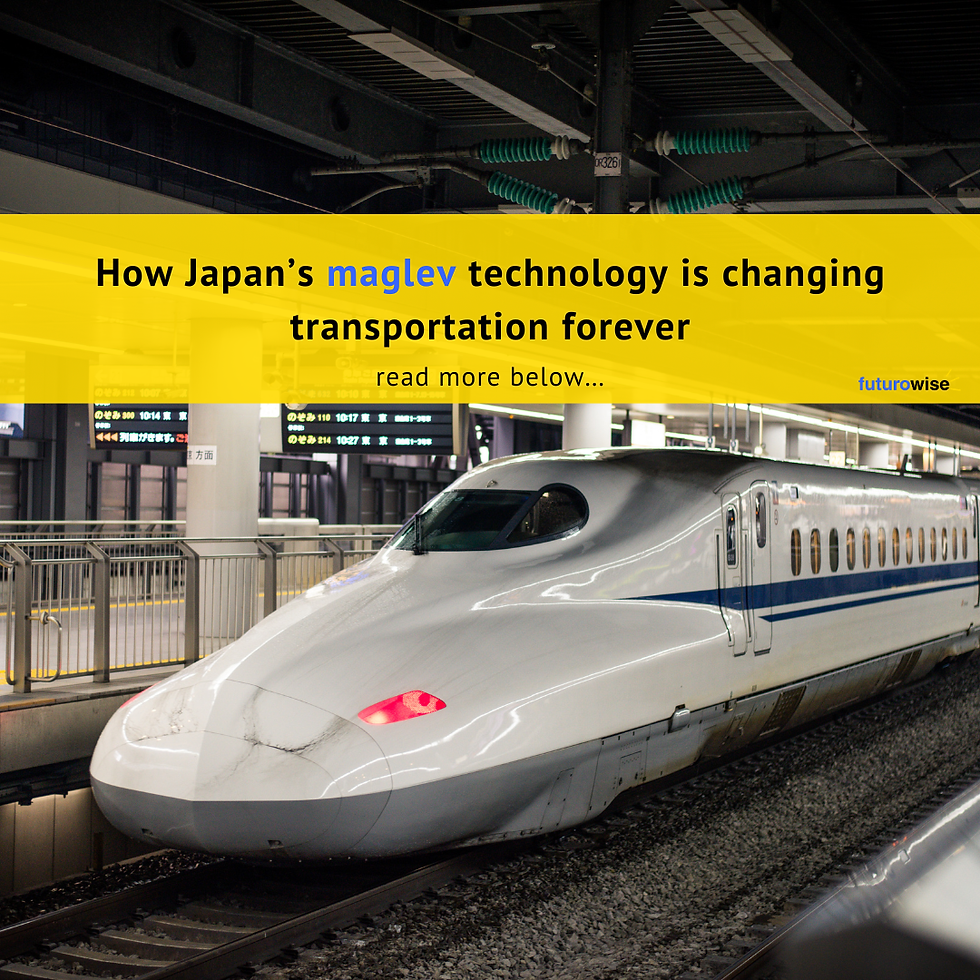
For decades, airplanes have dominated long-distance travel, while trains focused on comfort and reliability. Japan is now challenging that boundary. With the Chuo Shinkansen maglev train, the country is building a railway capable of traveling at around 500 kilometers per hour, faster than any commercial train in operation today. This is not a concept design or future promise. It is a real system under construction, designed to reshape how people move across land.
What Is the Chuo Shinkansen
The Chuo Shinkansen is a high-speed magnetic levitation railway being developed by Central Japan Railway Company, known as JR Central. It will connect Tokyo and Nagoya in about 40 minutes, compared to roughly 90 minutes by existing bullet trains. The line is planned to extend to Osaka in the future, cutting travel times across Japan’s most important economic corridor.
How Maglev Technology Works
Unlike conventional trains that run on steel rails, maglev trains float above the track using powerful superconducting magnets. When the train reaches high speed, it lifts several centimeters above the guideway, eliminating friction between wheels and rails. This allows the train to move faster, more smoothly, and with less mechanical wear. The Chuo Shinkansen uses superconducting maglev technology that Japan has been refining for decades.
Breaking Speed Records
Japan’s maglev system has already set world records. During test runs on the Yamanashi Maglev Test Line, trains reached speeds of over 600 kilometers per hour, making them the fastest ground vehicles ever recorded. These tests were not publicity stunts. They were part of a long-term engineering effort to prove stability, safety, and repeatability at extreme speeds.
Why Japan Is Building It Underground
One surprising aspect of the Chuo Shinkansen is that much of the route runs through tunnels. Japan’s dense cities, mountainous terrain, and strict environmental standards make surface construction difficult. By building underground, engineers reduce noise, minimize land acquisition, and protect communities along the route. This approach increases cost and complexity, but it reflects Japan’s emphasis on precision and long-term planning.
Safety at Extreme Speeds
Operating at 500 kilometers per hour requires exceptional safety standards. The maglev system is designed with multiple layers of redundancy, earthquake detection systems, and automatic braking technology. Japan’s long experience with earthquakes has shaped every aspect of the design. The goal is not just speed, but confidence that high-speed travel can remain safe even in one of the world’s most seismically active regions.
Economic and Social Impact
The Chuo Shinkansen is expected to strengthen Japan’s economy by shrinking travel time between major business hubs. Faster movement of people encourages collaboration, innovation, and regional development. For commuters and travelers, it offers an alternative to short domestic flights, potentially reducing congestion at airports and lowering carbon emissions.
Global Influence of Japan’s Maglev Vision
Japan’s maglev technology is also drawing international attention. The same system has been proposed for projects abroad, including earlier plans in the United States. By proving that ultra-high-speed rail is viable on a large scale, Japan is shaping how future transport systems might look worldwide.
Challenges and Delays
Despite its promise, the Chuo Shinkansen has faced delays and rising costs. Environmental concerns, local opposition, and complex geological conditions have slowed progress. These challenges highlight the difficulty of building mega-projects in modern societies where engineering ambition must coexist with environmental responsibility and public consent.
Looking Toward the Future of Land Travel
When the Chuo Shinkansen enters service, it will represent a new category of transportation, faster than traditional rail yet more sustainable than air travel for short distances. It challenges the idea that extreme speed belongs only in the sky. Instead, it suggests a future where land-based travel can be just as revolutionary.
The Chuo Shinkansen is not just about going fast. It is about what happens when a nation commits decades of research, testing, and patience to solve a complex problem. Japan’s maglev train stands as a reminder that the most impressive innovations are often the result of long-term thinking. At 500 kilometers per hour, the future of land travel is no longer theoretical. It is already taking shape beneath Japan’s landscape.