From Assembly Lines to Physical AI: How Industry Evolves
- Team Futurowise

- Oct 15, 2025
- 3 min read
Updated: Oct 16, 2025
Henry Ford was born in 1863 on a small farm in Dearborn, Michigan. From a young age, he was fascinated by machines, spending hours taking apart watches, bicycles, and engines to understand how they worked. This curiosity would shape his future and, eventually, the modern world.
As a teenager, Ford encountered his first gasoline-powered engine, sparking a lifelong passion for mechanized transport. In 1891, he became an engineer at the Edison Illuminating Company, gaining hands-on experience with electricity and machinery. During this time, he began envisioning a motorized vehicle that ordinary people could afford and use.
In 1896, Ford built his first automobile, the Quadricycle, in a small workshop behind his home. Though simple, it proved that his ideas were possible. He dreamed of more than just a single prototype; he wanted cars to be accessible to the masses. Early business attempts were challenging, but in 1903, with the support of investors, he founded the Ford Motor Company.
The real breakthrough came in 1913 with the moving assembly line. Inspired by industrial processes in other industries, Ford reimagined car production as a series of small, repetitive tasks performed along a conveyor. This reduced the time to build a Model T from 12 hours to just 90 minutes. The assembly line made cars affordable for ordinary families and set a new standard for manufacturing worldwide.
Ford’s innovations extended beyond machinery. In 1914, he doubled his workers’ pay to $5 a day, a bold move that reduced turnover and allowed employees to buy the very cars they were building. This created a new kind of consumer economy and demonstrated Ford’s belief that industry could improve everyday life.
The Model T became a symbol of freedom and mobility. Ford’s methods reshaped cities, factory design, and the global approach to industrial production. Despite criticism and competition, his vision and persistence transformed not only the automobile industry but modern society itself. Ford died in 1947, leaving behind a legacy of innovation and determination, a reminder of how one individual’s curiosity and persistence can change the world.
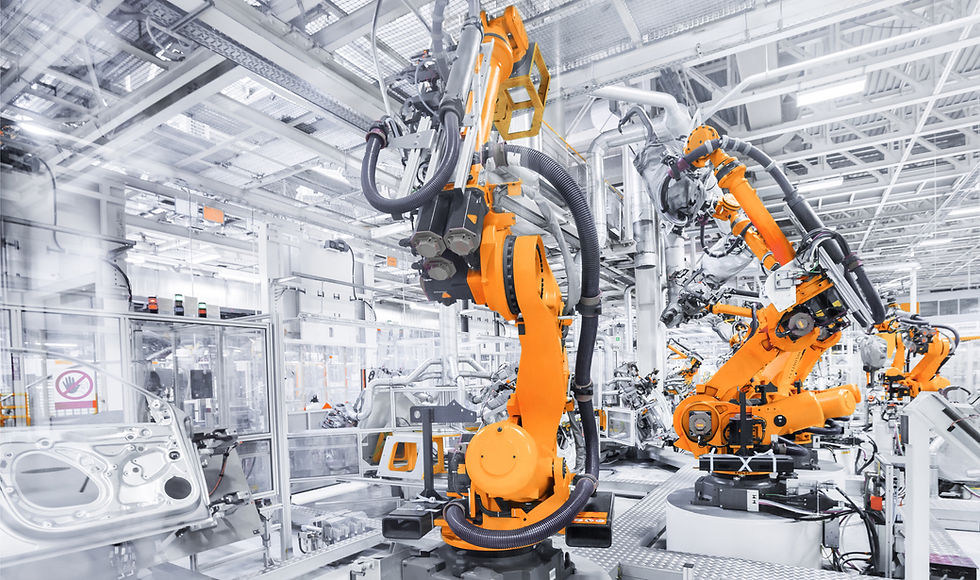
The story of industry did not end with Ford. Today, factory floors are transforming again. Where human workers once dominated repetitive tasks, a new generation of intelligent machines is emerging. Physical AI represents a paradigm shift: machines that perceive, reason, and adapt in real time, fundamentally redefining what automation can achieve.
Traditional industrial robots excel at precision but struggle with unpredictability. They operate in structured environments, following pre-programmed instructions. Physical AI changes this by combining advanced sensors, machine learning, and adaptive control systems. These machines learn from experience, adjust to variations, and make autonomous decisions that previously required humans.
In warehouses, Physical AI can handle boxes of varying sizes and conditions, learning optimal strategies independently. In manufacturing, it performs inspections with superhuman accuracy, detecting microscopic defects invisible to humans. In hazardous environments, it ventures where human safety would be at risk, from nuclear facilities to deep-sea installations.
The technology driving this revolution is multifaceted. Computer vision enables machines to interpret their surroundings, neural networks process vast sensory data, reinforcement learning allows self-improvement, and edge computing ensures real-time decision-making. Industries worldwide report transformative results: production efficiency gains of 30 percent, near-perfect defect detection, and logistics operations running faster and safer.
Physical AI also addresses labor shortages, enables continuous operations without fatigue, and handles dangerous tasks. But it requires a new kind of workforce engineers who understand both traditional systems and artificial intelligence, bridging past industrial innovation with the future of automation.
From Ford’s assembly line to intelligent machines today, the story of industry is one of relentless curiosity, experimentation, and transformation. The tools have changed, but the spirit of innovation continues to drive the world forward.
Futurowise: Preparing Students for the Physical AI Era
At Futurowise, we recognize that understanding Physical AI & Industrial Bots is essential for future career readiness. Our specialized programs provide students with comprehensive knowledge of robotics fundamentals, AI principles, and their real world industrial applications. Through interactive learning experiences and expert led sessions, we equip the next generation with skills demanded by tomorrow's industries. Our Physical AI & Industrial Bots course covers computer vision, machine learning for robotics, sensor integration, and autonomous systems design. Students gain practical insights into how these technologies are reshaping manufacturing, logistics, and automation industries worldwide. We bridge theoretical knowledge with industry applications, ensuring students understand not just how these systems work but how they transform entire sectors.
Discover how Futurowise can prepare you or your child for careers in this revolutionary field.
Schedule a call: https://calendly.com/futurowise-info/zoom